


Getting Married in France: What International Couples Need to Know
Here is the honest headline for international couples: almost no one gets legally married in France. French law asks that at least one of you lives in the commune where you marry for around 40 days beforehand, so the vast majority of destination couples complete the paperwork at home and hold their real celebration — the ceremony, the vows, the dinner under the plane trees — in France. Once you understand that, a destination wedding in France becomes far simpler than most couples expect, and every bit as meaningful.
We plan destination weddings across Europe for couples coming from the UK, the US and beyond. France rewards couples who love a certain kind of romance: châteaux and candlelight, long dinners, serious food and wine, and landscapes that do half the styling for you.
Can foreigners legally get married in France?
Technically yes, practically rarely. To hold a legal civil ceremony in France, at least one partner must have lived in the commune (the local district) for a minimum residency period — in practice around 40 days once the required notice is included. The civil ceremony itself must happen at the mairie, the town hall, conducted in French by the mayor or a deputy.
For couples flying in for a week, that residency requirement rules out a legal French ceremony. So here is what nearly all of our couples do instead. They complete a short legal ceremony at their local registry office at home, often just the two of them plus witnesses. Then they hold a symbolic ceremony in France, led by a celebrant, in the setting they actually dreamed of.
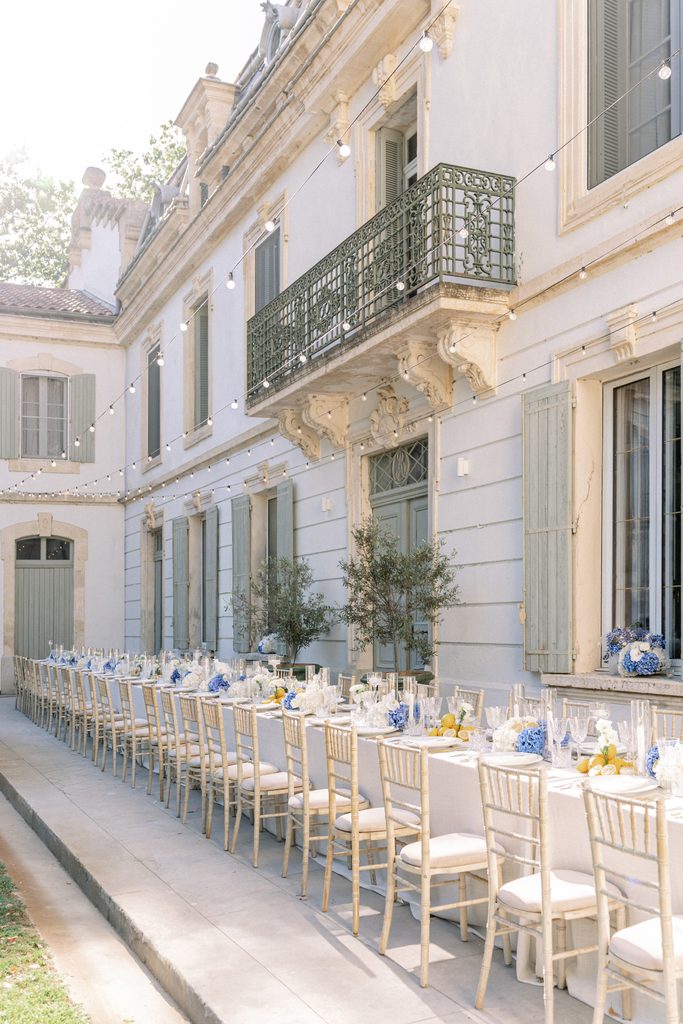
A symbolic ceremony is not a lesser version of the day. Your guests will not see a difference. You can exchange vows in a château courtyard, a lavender field or a clifftop garden, with readings, music and all the emotion of the day — without a single piece of French bureaucracy attached.
Where in France should you get married?
France offers more variety than almost any destination in Europe. These are the regions international couples ask us about most:
- Provence — lavender, olive groves, golden stone bastides and that unmistakable southern light. The classic choice for relaxed, outdoor-led weddings.
- The French Riviera (Côte d’Azur) — glamour, sea views and grand hotels between Nice, Cannes and Saint-Jean-Cap-Ferrat. Suits couples who want polish and a touch of occasion.
- The Loire Valley — fairy-tale château country, within easy reach of Paris. If your dream involves turrets, this is where it lives.
- Dordogne and the south-west — honey-coloured villages, river valleys and genuinely good value compared with the Riviera.
- Paris — for intimate weddings and elopements rather than big celebrations; the city does romance at any scale, but large exclusive-use venues are rare.
What kind of venues can you hire in France?
The château is the headline act, and for good reason. Many are available for exclusive use across a full weekend, with bedrooms on site for your closest guests. That changes the shape of the wedding: it becomes a two- or three-day house party rather than a single afternoon.
Beyond châteaux, look at bastides and mas (Provençal manor houses and farmhouses), wine domaines in Bordeaux, Burgundy and the Rhône, and boutique hotels along the coast. Each carries a different mood — a domaine wedding feels generous and rooted in the land, while a Riviera hotel wedding feels like a glamorous occasion.
One thing to check early: many rural French venues are “dry hire”. You rent the building and grounds, then bring in your own caterer, furniture, lighting and sometimes even power. It is where a planner earns their keep, because coordinating six suppliers onto one estate is a different job from booking a hotel package.
How much does a destination wedding in France cost?
France sits toward the upper-middle of European destination pricing — generally above Puglia or inland Spain, with the Riviera at the premium end and the south-west noticeably gentler. Your three biggest variables are the venue hire, catering and guest count.
French catering deserves its own line in the budget — and in the best way. Multi-course dinners, proper wine pairings and cheese served as a course are part of the culture, and your guests will remember the food for years.
When is the best time to get married in France?
Late May to early October is the season, and June and September are the sweet spots. You get warm, settled weather without the fierce heat of late July and August — which is also when the French themselves holiday, so some suppliers close and coastal prices peak.
In the south, always plan for wind as well as sun. The mistral in Provence can arrive uninvited, so a beautiful wet-weather (and wind) plan is not a nice-to-have; it is part of the design. Spring and early autumn weddings in the Loire or the south-west can be glorious and noticeably better value.
Do you need a wedding planner for a France wedding?
For a destination wedding in France, we would say yes — and not only because it is our job. The reasons are practical. Dry-hire venues mean assembling your own supplier team in a country you do not live in. Contracts, deposits and quotes arrive in French. Distances are real: your venue, florist and caterer may be an hour apart, and someone has to make the logistics invisible on the day.
A planner who already knows the region brings a tested supplier team, honest advice on venues before you fly out, and a calm hand between your booking and the wedding weekend itself. You plan the fun parts; the spreadsheets happen quietly in the background.
Yes. A wedding planner in France is absolutely essential, and that holds for luxury weddings and smaller budgets alike.
With the more DIY venues, there is a lot of work to be done. Rentals, lighting and bringing in your own alcohol all need sourcing, and a whole logistics and coordination piece goes with them. Someone has to bring every supplier together and make it all run on the day.
Premium venues will often require a planner too. Some have their own coordination team, but their role is different. They do not deal with outside suppliers, styling or managing your overall wedding budget. Relying on them alone also limits your options.
So if your venue has a planning team, that’s great. We see them as an addition to our planning team rather than a replacement, because the two roles are very different.
French châteaux in particular are often very large venues. They need a lot of logistics and a big team on the ground, and they come with plenty of challenges of their own. That’s where we come in.
FAQ: getting married in France
Can we legally marry in France as foreigners? Only if one of you meets the roughly 40-day residency requirement in the commune where you marry. Most international couples legally marry at home and hold a symbolic ceremony in France — guests notice no difference.
How far in advance should we book a French wedding? Twelve to eighteen months is ideal, especially for exclusive-use châteaux in June or September. Twelve months is workable; the best venues and photographers go first.
Is a symbolic ceremony in France worth it? Completely. You gain total freedom over the location, the celebrant, the words and the music — none of which a French civil ceremony at the mairie would allow.
Is France more expensive than Italy for a wedding? It depends on the region. The Riviera rivals the Amalfi Coast; the Dordogne or Loire can compare well with Tuscany. If budget is the deciding factor, it is worth comparing both countries before you choose.
Ready to start planning your wedding in France?
If France is calling — a château weekend, dinner among the vines, vows in the Provençal light — We would love to hear your plans. We design and plan destination weddings across France and Italy for couples who want the whole weekend to feel effortless. Get in touch with us here and tell us what you are imagining, and we will see where it could come to life.

leave a comment!